Saturday, July 2, 2016

Sequencing and Going With the Flow

When the knifemaker's aunt initially conceived of this summer continuing education experience, she thought the metalworking learning would progress in a linear format, from step to step. Forging the nail, profiling, grinding, tempering, handle prep, and polishing...done.

However, learning in a working knife shop is anything but linear. The business of build-a-knife classes, customers purchasing custom work, and preparing inventory for upcoming shows are activities that are juggled with the process of teaching someone skills. The knifemaker's aunt has come to understand the rhythm of days, and the importance of being able to self-direct when necessary. Once skill is learned, it is applied as needed without specific direction so everything and everyone works in tandem.

Source: www.reddit.com

Profiling the Forged Nail

Once the nail has been forged, the knifemaker's aunt began to profile them. This is when the nail starts to take on the recognizable shape of a knife. Using a 120 grit belt sander, the blade is shaped followed by the spine and then the finger notch. The videos below show the progression. In doing this procedure, it became clear where all the dark colored dust comes from that the knifemaker's aunt keeps sweeping up. Now, she's making piles of metal colored dust herself.


 This picture shows the difference between the forged nail and the profiled nail. Still rough, but the identifiable knife shape is starting to take shape.


All the profiles passed inspection and will move on to the next step. HOWEVER, since a show is coming up and shop inventory is down AND the knifemaker's aunt has proven herself to be an acceptable profiling worker, tomorrow will be spent profiling horseshoe knives.


Friday, July 1, 2016

Storytelling in the Knifemaker's Shop

Today began with the knifemaker and knifemaker's dad working on special orders. The sun shines hard on the working deck so even though the mountain could be seen [remember a previous post about humidity], it was too hot to work for the extended period of time needed to forge many dozens of nails. In the  meantime, the knifemaker's aunt swept up grindings and accumulated dust from months of work. It was satisfying work exposing wood flooring unseen for quite a while. The knifemaker's lady friend ordered materials to make forges. Nails were counted and sorted, blades were ground and polished, and in general everyone kept busy.

Agitating laundry, one direction
and then another.
As friends dropped by to talk about this and that, companionable stories were swapped. One story to be shared, in keeping with yesterday's laundry post, was an analogy about Maytag washers and dryers: Life is like a Maytag - you get into hot water, are agitated one direction and another until beliefs are shaken or rubbed off before being spun around in a frenzy....As you are wondering what the bejeebers just happened, lo and behold the drama continues as you are thrown into hell and tumbled heads over heels. When it's all over, it was about appearances and money all along.

Other stories were about Millenials and the stereotypes that define the 20-somethings. The knifemaker IS a millenial, as is the knifemaker's lady friend and although they admitted to recognizing some of the traits. those assembled agreed they were not typical. This YouTube was shared and inspired chuckles all around:


The day drew to a close when a couple events collided: a walk-in student and her father took a class to make a railroad spike knife, and two babies birds fell out of a nest in the shop chimney. The student is active in FFA and 4H and had a blast making her own knife. The baby birds were scooped up and put into a box, given water, and the local petting zoo called.  


The chimney is behind one of the grinding stations, but should probably be blocked at the top where the nesting bird got in. Even though the sweeping cleared much of the dust and grinding debris, the shop is still dirty and certainly no place for baby birds!

All is all, a pleasant day. The knifemaker's aunt did not produce much in the way of knives. She allowed her hand to heal a bit before diving back into forging tomorrow. In the meantime, she kept herself busy and learned quite a bit about personality, humanity, and life.

Thursday, June 30, 2016

Warshin' Up the Clothes

The knifemaker's aunt packed white t-shirts and dark pants for this month of learning. The idea was to treat work clothes as wear-and-wash items from day to day, nothing fancy or fanciful. White may not have been the best choice cleaniness-wise because [especially after today's efforts to pound metal into a shape] blacksmith work is dirty. Sweeping up the filings and grinding dust is dirty. Even tonight when showering, there was dark,  metal-colored dust in the knifemaker's aunt's ears and nose.

 There are several ideas for whitening clothes.
The white t-shirts covered by the ochre-dyed leather apron became not white under the apron where the yellow color wore off onto the  damp shirt as the knifemaker's aunt sweated. **sigh*  As a strange bit of information, did you know horse urine can brighten whites?  Yessirree, among the many ways to clean white clothes Lisa Nelsen-Woods at Condo Blues says horse urine was used in Elizabethan times to keep white clothes white but yikes!, there are no horses around the knife shop and besides, yikes! 

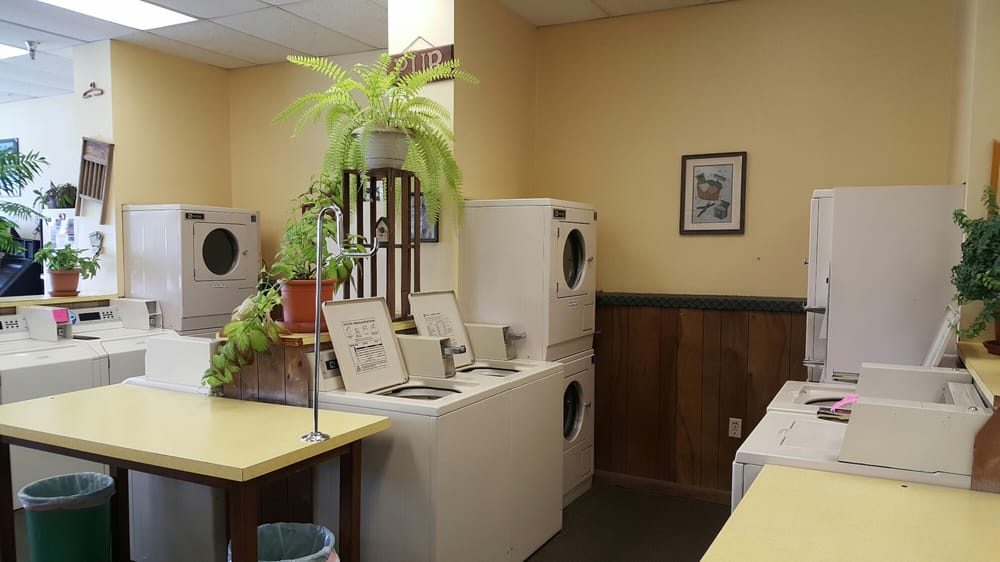
To get the accumulated bag of clothes clean, the knifemaker's aunt left the shop a little early to get a $1.99 jug of laundry detergent and visited the Warsh House, a laundromat in the area where local people sit and chat about town activities. The Warsh House has a sign on its door that says Open: around 8 - 8:30am, Closed: most likely before 9am. What's not to like about a place that shares information like that?  Everybody the knifemaker's aunt came in contact with was helpful, but not clinging-ly so. She put a $10 bill into the change machine and was rewarded with the cheerful ckinkclinkclink of 40 quarters dropping into the metal dispenser bowl. She then threw all the clothes into one washer with some of the $1.99 soap and viola! the clothes were clean. Even the white t-shirts came out white. An hour later, the knifemaker's aunt had folded the clothes and was walking to the car.
The washers and dryers used
in the Warsh House.
YeeHA! Tomorrow the cut nails will forged with fresh clothes!


First Day of Metalwork

Speaking briefly and to the point: the knifemaker's aunt needs to strike hot metal harder, and the knifemaker has an extensive amount of patience.  This initial hammering produced nothing but additional explanations from the knifemaker. The hammer felt heavy, the tongs felt clumsy and there was the ongoing fear that even when the metal was not red, it was still hot.


One more time....

The point is to  broaden the face of the cut nail so there is a bigger surface area to work with, and to relieve the metal of any curves.

Tap, tap, tapping does not cut it and in this morning of learning curve, the hammer became heavier and heavier as the nails were going back into the forge over and over. In the end, the knifemaker's aunt made 14 acceptable pieces of forged nails to use for the knives (devoting about 3 hours of time) whereas the knifemaker could make 17 in 20 minutes.

14 that passed inspection...
Broaden the nail....
The knifemaker's experience certainly explains some of the that; the knifemaker's aunt's timidity does too. Watching the knifemaker actually make his 17 made it clear what needed to be done. Modeling was better instruction than verbal teaching. The aunt must remember that when teaching her students!


The undesirable curve.

Straightening the spine....

Notice the hammer-holding posture but it produced
the blisters and red marks on the knifemaker's aunt's hand.


Wednesday, June 29, 2016

Trimmin' Sheaths and Checkin' Humidity

While the knifemaker teaches the family of three boys and a dad, the knifemaker's aunt trimmed the sheaths in preparation for sewing. Of the 110 sheaths, it turns out there are 34 left-handed sheaths. That would be 33% for left-handed need, which is the upper end of the spectrum for left-to-right-handedness in the population. Some people will not care which way the knife turns, but next time extra care will be taken when tracing the template. For now, however, all is ready for the next step.

If you can see the mountain from the shop deck,
then the humidity is low. See the light blue haze
 of mountain in the distance? Low humidity.
Until then, the outdoor humidity has dropped (the knifemaker showed his aunt how to check the mountain) and a pleasant Tennessee breeze is wafting through the shop. It was the perfect time to go outside and sweep out the windblown debris that has accumulated under the front deck over time. When the area was cleared, the bags of waste await a trip to the landfill. The knifemaker and the knifemaker's dad are now preparing to do a lattice-work underpinning in the next couple weeks to keep the trash from blowing underneath their work deck in the future. This will be done after the July show when all the knifemaker's posse (dad, aunt, and lady friend) is on board to do the repairs on the entrance ramp. It will be a new look!

There are no classes tomorrow, so the day will be devoted to firing up the forge and making nail knives.


Parts of a Knife

The knifemaker's aunt watched the knifemaker explain to three boys the parts of a knife as they designed what they wanted to build. Simple, so simple, yet the patience the knifemaker used with the youngsters was a good model for handling students at school...a reminder to the aunt that what is obvious to an expert is actually brand new to a young person. Imparting the wisdom with enthusiasm makes it fun for everyone concerned.

Once the parts were sketched and explained, the information was transferred to physical knives in the showcase and comparisons made. The spine, the point, and the cutting edge exists no matter what the design, even the little nail knife.

 On to other chores...

Tuesday, June 28, 2016

Seating

Blogging station
The knifemaker's aunt needs some seating for the blogging station, and eventually for doing the work of metalworking. She ran out to Big Lots and bought some saddleback stools. They were easy to assemble in the hotel room, in SPITE of being told at the store the tools came with the stools in the boxes.

Visitor seating
Luckily, the knifemaker's aunt keeps a tool bag in the car trunk and was able to access her drill. Unfortunately, the flathead screwdriver picture showing on box really should have been a phillips screwdriver. No matter, a quick trip to Harbor Freight on the way to the knifemaker's shop garnered a phillips and seating happened.

Saddleback seats are wide (yay! for the knifemaker's aunt's behinee!) and stable (great for visitors who are taking a build-a-knife class).

Money well spent!

Sheaths - Part 2: Left Hand or Right Hand?

www.lefthandedworld.com
Today was devoted to working with the sheath blanks the knifemaker's aunt and the knifemaker's lady friend cut yesterday from colored leather scraps. Did you know when making sheaths, there are left-handed knife sheaths and right-handed knife sheaths. The knifemaker's aunt knows about scissors, but handedness matters with knives? Who knew?

Well, the knifemaker knew and he stopped mid-strike in a project he was working on and whipped around to stare at what the knifemaker's aunt was doing. OH my! Being left handed herself, the old girl was folding the sheaths to hold left-handed knives. The problem with that is there are more right handed people in the world than there left handed people.

These are the right handed sheaths. 
These are the left handed sheaths.
Why would that be? A scientist at the Center for the Integrative Study of Animal Behavior at Indiana University suggests reasons for why the percentages favor right handedness but besides knowing that, what is the difference with knives? The knifemaker's dad explained that right-handed sheaths curve to follow the shape of the blade. When a right handed person pulls a knife out of a right-handed sheath, the sharp edge of the blade is down. If a left handed person pulls the same knife out of the same sheath, the sharp edge of the blade would be upside down (the sharp edge on top). The mission for the knifemaker's aunt was to limit the number of left-handed sheaths in favor of the right-handed ones. The deciding factors for which blanks to use for which handedness came down to what the front and back look like (remember from a previous post that some scraps had marking on the back) and how the template was turned when the tracing happened.

The silver time stamp on the backside of this sheath became
the interior of a left-handed sheath -- a silver lining, so to speak!

The bags of left-handed and right-handed sheaths ready for sewing.
The only problem, if it can be considered a problem, is some colors of the leathers became only left headed sheaths. For example, orange was a hot color that was frequently marked with time and date stamps. Those lefties are lucky to have such a lovely color. Blue, majenta, and red leather was used in a proportionate split between left- and right-handed sheaths. Tomorrow starts the blacksmithing...YEeHAaAA!!


Monday, June 27, 2016

Sheaths - Part 1

Already the first day, the knifemaker's aunt is cutting leather to make sheaths for nail knives. That's the kind of knife she will be making: a knife from a cut nail.

These are cut nails from
the knifemaker's shop being made into
knives in the days to come.
Interesting enough, cut nails have quite a long history, as Paul Fourshees explains, as a fastener and as items of torture. The Bible even makes references to nails. I thought it was particularly intriguing to know "the holding power of common nails drops by half within two days after being driven."  Who knew? In addition, did you know in the 1600s, the Virginia legislature had to pass a law to keep people from burning down their own houses when moving in order to reclaim the nails -- handmade nails, made one at a time, were so valuable. WHO knew?!

1- Suitcase full of leather scraps.
Back to the sheaths. Why make the sheaths before the knife? It would seem like putting the cart before the horse. However, nail knives are consistently sized so the sheaths can be made beforehand without sizing worries unlike sheaths for custom knives when no two are alike.

Today, the knifemaker has 3 students in the shop participating in a build-a-knife class. While that is going on, the knifemaker's aunt and the knifemaker's lady friend are in the office cutting sheaths from a suitcase of leather scraps purchased online. WHOA! Take a gander at those colors!

2- The sheath shape drawn on leather scrap.
Initially, the template is traced onto the scraps. Because leather is a natural product, some of the scraps have flaws. Those areas are avoided. As the pile of templates accumulated, it was time to cut. A couple different types of scissors were used. It seemed that although leather feels soft to the touch, it sure seems to ride rough on the edge of the blades on scissors. Two pairs got tight at the hinge and seemed to not cut as cleanly as when begun. Using no-name blue handled scissors from the office supply drawer worked much better.

3- The leather scraps on the floor.
There were a lot of scraps on the floor as the pile of sheaths got bigger. After counting and grouping, there were a total of 110. The cutting hand thumb of both women had a crimp at the first knuckle, but a feeling of satisfaction permeated the shop.

Job well done!


4- Sheaths piled up after being cut
5- The sheaths put into piles - 110 sheaths.

Sunday, June 26, 2016

Starting with Smashed Clementines

After much preparation, and packing, and hubbub of getting affairs in order to leave home and hearth for a little more than a month, the trip is begun. Pulling out of the driveway exposes the half dozen clementines that were dropped and thought retrieved. Who knew there were so many? Left in the wake of the knifemaker's aunt's car were smashed clementines on her husband's new white cement driveway.

Source: www.reddit.com

Yet, even with a juicy beginning, the trip to Pigeon Forge went well. Traffic ran smooth, none of the deer along the side of the road jumped onto I-81, and the hotel staff was especially cheerful. The month of learning is off and running!